 Neel Thakkar
The way customers interact with businesses has changed significantly in recent years. Today, customers engage with brands through websites, mobile applications, customer portals, e-commerce platforms, social media channels, messaging apps, and increasingly through AI-powered assistants. As a result, organizations are expected to deliver seamless, personalized, and consistent experiences across every touchpoint while maintaining agility, scalability, and operational efficiency.
To meet these growing demands, many businesses are adopting Headless Architecture, a modern approach that separates customer-facing experiences from backend systems. Traditional architectures often limit flexibility and slow the ability to innovate, making it difficult to support new channels and emerging technologies. Salesforce Headless 360 addresses these challenges by enabling organizations to create highly customized digital experiences while leveraging Salesforce for customer data, automation, and business processes. In this blog, we will explore Salesforce Headless 360, its key components, benefits, real-world use cases, and why Headless Architecture is becoming increasingly important in the Agentic AI era.
What Is Salesforce Headless 360?
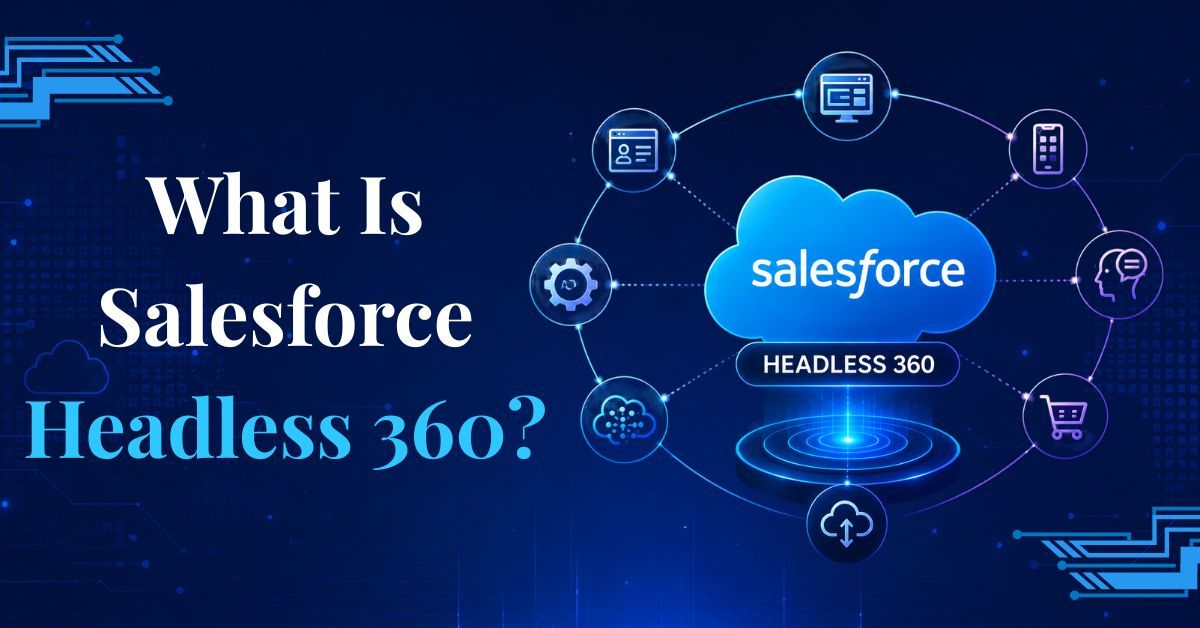
- Salesforce Headless 360 is a modern Headless Architecture approach that separates the frontend user experience from Salesforce backend services. This allows businesses to create unique digital experiences while continuing to leverage Salesforce as their centralized platform for customer data, workflows, and business processes.
- Unlike traditional systems where the user interface and backend are tightly connected, Headless 360 enables independent development of each layer. This flexibility allows organizations to innovate faster without disrupting critical backend operations.
- The Headless Architecture follows an API-first model, where frontend applications communicate with Salesforce through APIs. This makes it possible to deliver experiences across websites, mobile applications, portals, kiosks, and AI-powered interfaces.
- Developers are free to use modern frameworks such as React, Angular, Vue.js, and Next.js to build engaging user experiences. This freedom helps teams choose technologies that best fit their project requirements and development expertise.
- Salesforce remains responsible for managing customer records, automation, security, workflows, and business logic. This ensures consistency and reliability while allowing flexibility on the presentation layer.
- Organizations can update or redesign customer experiences without making major changes to backend systems. This reduces development complexity and accelerates innovation cycles.
- As digital channels continue to expand, Headless 360 provides a scalable foundation that enables businesses to deliver consistent and personalized experiences across every customer interaction.
Why Modern Businesses Need Headless Architecture
- Customer expectations have changed significantly over the past decade, with users demanding faster, more personalized interactions. Businesses that fail to meet these expectations often struggle to maintain engagement and customer loyalty.
- Traditional architectures were primarily designed for websites and basic online interactions. They often lack the flexibility needed to support today's omnichannel customer journeys and rapidly changing business requirements.
- Many organizations operate with tightly coupled systems where frontend and backend components depend heavily on each other. This dependency often slows development and makes updates more difficult to implement.
- As businesses expand into mobile applications, customer portals, and AI-powered experiences, traditional systems can become barriers to innovation. New digital channels often require extensive customization and integration efforts.
- Maintaining consistent customer experiences across multiple platforms becomes increasingly challenging when data and functionality are distributed across disconnected systems.
- Development teams frequently encounter delays because changes in one part of the system may require modifications elsewhere. This can increase costs and extend project timelines.
- To remain competitive in today's digital economy, organizations need flexible architectures that support rapid innovation, seamless integrations, and scalable customer experiences.
Understanding salesforce Headless 360 Architecture
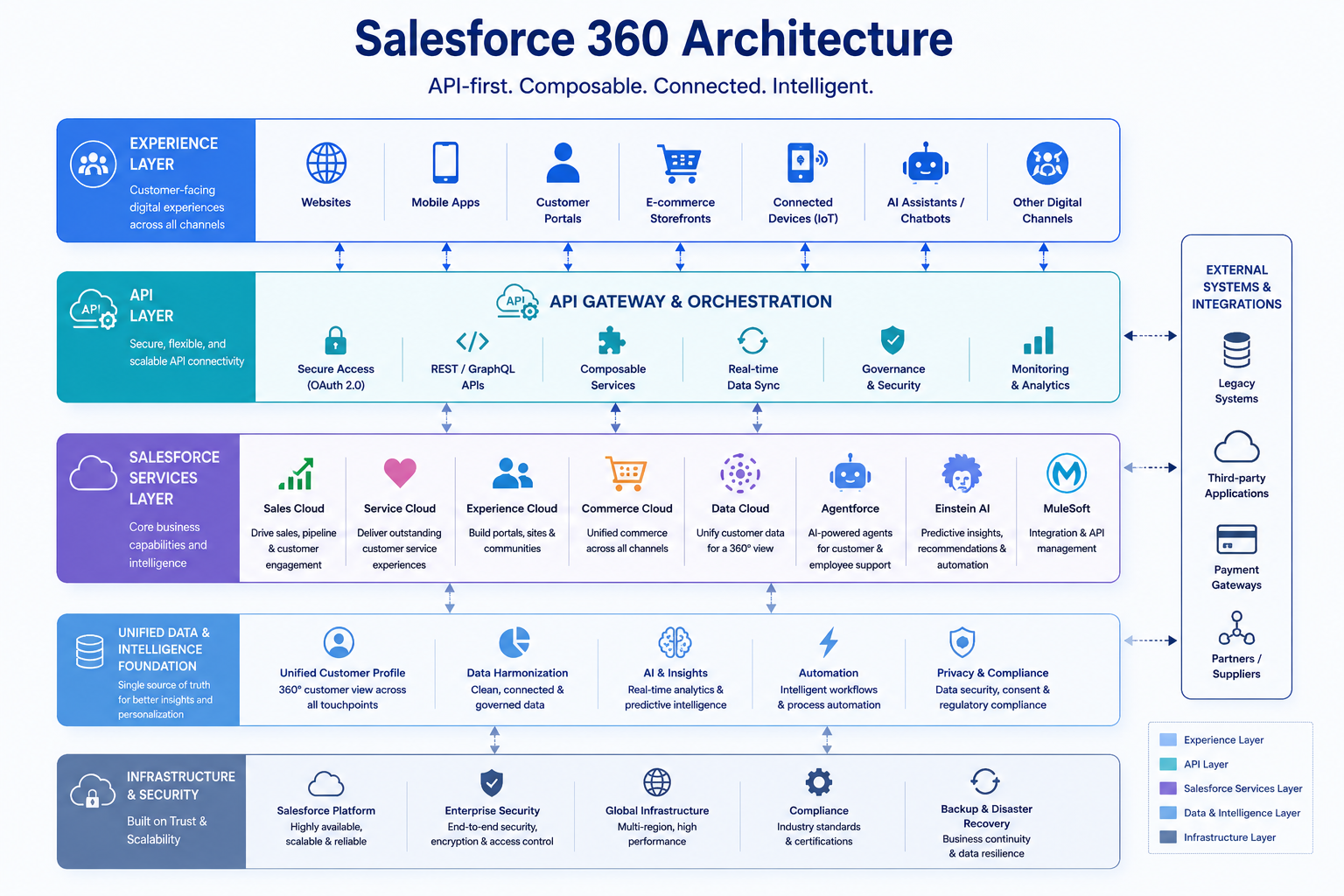
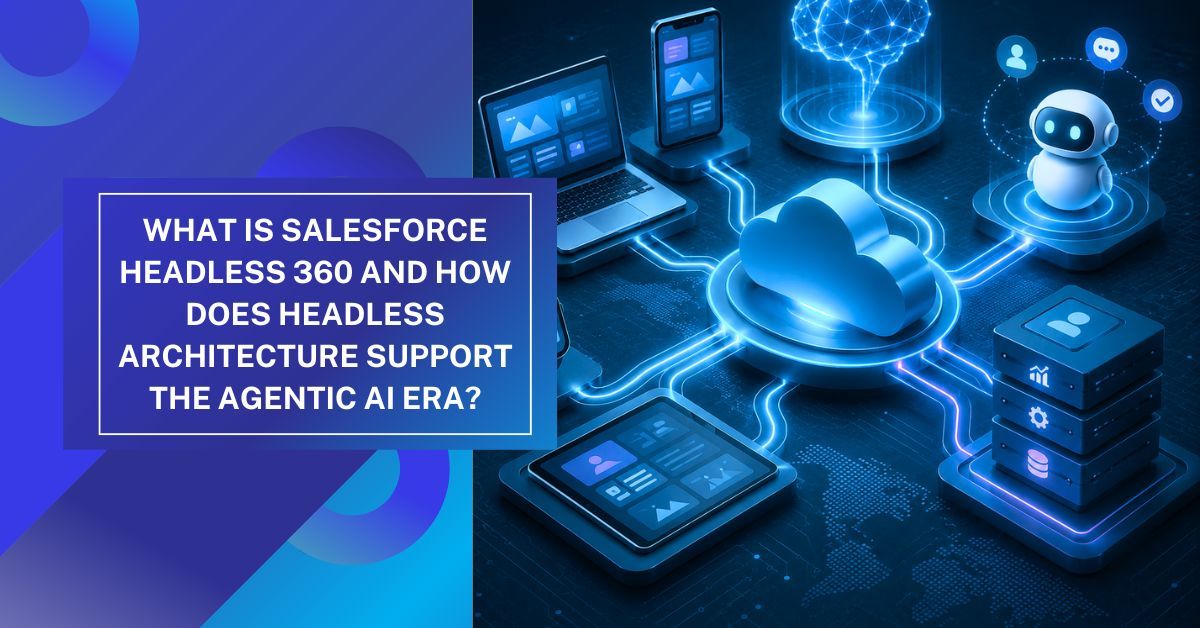
- Salesforce Headless 360 architecture separates customer-facing experiences from backend business services. This enables organizations to create highly customized digital experiences while maintaining centralized control over customer data, workflows, and business operations.
- The architecture follows an API-first approach that connects frontend applications with Salesforce services through APIs. This allows websites, mobile apps, customer portals, and AI-powered interfaces to access business capabilities without relying on predefined Salesforce user interfaces.
- At the core of the architecture is the Salesforce Platform, which acts as the system of record for customer information and business processes. Organizations can leverage Salesforce data, automation, and workflows across multiple digital channels from a single platform.
- The Experience Layer consists of customer-facing channels such as websites, mobile applications, e-commerce storefronts, customer portals, connected devices, and AI assistants. Businesses can design unique user experiences while ensuring consistent access to backend services.
- The API Layer serves as the connection point between frontend experiences and Salesforce services. It enables secure data access, real-time communication, and seamless integration across multiple applications and digital touchpoints.
- The Salesforce Services Layer includes solutions such as Sales Cloud, Service Cloud, Experience Cloud, Commerce Cloud, Data Cloud,Agentforce, Einstein AI, and MuleSoft. These services provide the business logic, automation, intelligence, and operational capabilities that power digital experiences.
- A unified data and intelligence foundation ensures customer information remains consistent across all channels. By combining customer data, AI capabilities, and automation, Salesforce Headless 360 architecture helps organizations deliver personalized, scalable, and connected experiences across the entire customer journey.
What Are the Key Components That Power Headless Experiences?
1. Salesforce APIs
- Salesforce APIs enable secure communication between frontend applications and Salesforce backend services. They act as a bridge between user-facing experiences and core business systems.
- These APIs provide real-time access to customer records, products, service requests, and workflows. Developers can retrieve and update data to deliver seamless customer experiences.
- API-based connectivity supports multiple digital touchpoints such as websites, mobile apps, and portals. Using shared backend services helps maintain consistency across all channels.
- Salesforce APIs improve scalability through reusable services and secure integrations. They reduce maintenance efforts while enabling faster business operations and decision-making.
2. Salesforce Data Cloud
- Consolidate customer data from multiple systems into a single, unified profile. Enable teams to access accurate and complete customer information.
- Improve personalization by leveraging real-time customer insights and behavior. Deliver relevant content, recommendations, and interactions across channels.
- Ensure consistency in customer experiences across web, mobile, and service platforms. Maintain a seamless journey regardless of the engagement touchpoint.
- Enhance decision-making with a centralized view of customer data and activity. Empower teams to respond faster and provide more effective support.
3. Experience Cloud
- Enable the creation of customer, partner, and employee portals using Salesforce capabilities. Provide secure access to information, services, and collaboration tools across audiences.
- Support highly customized digital interfaces when combined with headless architecture. Allow organizations to design unique experiences tailored to specific business needs.
- Deliver consistent user experiences across multiple digital channels and touchpoints. Ensure seamless interactions while maintaining centralized data and business processes.
- Accelerate portal development with reusable Salesforce services and integrations. Reduce implementation effort while improving scalability and long-term maintainability.
4. Commerce Cloud
- Build flexible digital storefronts that support unique customer experiences across web and mobile channels. Enable seamless shopping journeys tailored to evolving business and customer needs.
- Create customized commerce experiences without being constrained by traditional frontend limitations. Deliver engaging interactions that strengthen brand identity and customer loyalty.
- Integrate commerce capabilities with Salesforce to streamline business operations and customer engagement. Ensure consistent experiences across multiple touchpoints and sales channels.
- Manage products, pricing, inventory, and orders through Salesforce with centralized control. Improve operational efficiency while maintaining accurate and real-time commerce data.
5. Agentforce
- Introduce AI-powered agents that engage customers across digital channels and provide personalized assistance.These agents can automate routine interactions while improving response times and customer satisfaction.
- Leverage real-time Salesforce data to deliver accurate recommendations and contextual support.Access to up-to-date information enables smarter decisions and more relevant customer experiences.
- Automate business processes by triggering workflows, updating records, and completing transactions.This reduces manual effort, increases efficiency, and ensures consistent operational execution.
- Enable intelligent task execution through seamless integration with Salesforce services and applications.AI agents can perform actions autonomously while maintaining alignment with business rules and goals.
6. MuleSoft
- Connect Salesforce with external systems, applications, and enterprise platforms. Enable seamless communication between business-critical technologies.
- Integrate data from multiple sources into a unified ecosystem. Enable a unified flow of data across connected systems to improve visibility and business efficiency.
- Automate workflows by linking Salesforce with third-party applications. Streamline business processes and enable faster execution across connected systems.
- Support real-time data exchange across connected environments. Enhance visibility, collaboration, and decision-making capabilities.
7. Combined Ecosystem
- Bring together Salesforce services, data, and automation into one unified platform. Enable seamless connectivity across customer, partner, and employee experiences.
- Centralize business processes while maintaining flexibility across digital channels. Improve operational efficiency and consistency throughout the organization.
- Deliver personalized customer interactions using real-time data and insights. Create engaging experiences across web, mobile, and AI-powered touchpoints.
- Support AI-driven innovation with scalable and secure platform capabilities. Empower businesses to automate workflows and enhance decision-making.
Benefits of Salesforce Headless 360 for Businesses
1. Faster Time-to-Market
- Organizations can launch new digital experiences more quickly with Headless Architecture, without extensive backend changes.
- Frontend teams can innovate independently, reducing development cycles and accelerating releases.
- Faster deployment helps businesses respond quickly to market demands and customer expectations.
- Reduced dependencies improve project efficiency and overall delivery speed.
2. Greater Flexibility and Customization
- Headless Architecture enables organizations to create tailored digital experiences that align with their brand strategy and evolving customer expectations.
- Developers have the freedom to use modern frameworks and technologies.
- Custom interfaces can be created for different channels and audiences.
- This flexibility helps organizations stand out in competitive markets.
3. Improved Scalability
- With Headless Architecture, frontend and backend systems can scale independently based on business requirements.
- Organizations can handle increased traffic without impacting core operations.
- Resources can be optimized for better performance and reliability.
- The architecture supports long-term growth and expansion.
4. Consistent Omnichannel Experiences
- Businesses can deliver seamless interactions across websites, mobile apps, portals, and AI interfaces.
- Customer data remains centralized within Salesforce for consistency.
- Users receive a unified experience regardless of the channel they choose.
- This helps create stronger customer relationships and a more consistent brand experience.
5. Enhanced Personalization
- Unified customer profiles from Data Cloud enable tailored interactions.
- Businesses can deliver relevant content, recommendations, and services.
- Real-time customer insights improve engagement across touchpoints.
- Personalized experiences help strengthen customer relationships.
6. Increased Operational Efficiency
- Headless Architecture supports shared backend services that help eliminate redundant development work and promote greater consistency across applications.
- Teams can focus more on innovation rather than managing complex integrations.
- Automated and connected workflows enable teams to operate more efficiently and deliver results faster.
- Maintenance becomes easier with a modular architecture.
7. Future-Ready Digital Foundation
- Businesses can more easily adopt emerging technologies such as AI, automation, and intelligent agents.
- Organizations can adapt more easily to evolving customer expectations.
- Headless Architecture provides the flexibility needed to support future business initiatives and emerging technologies.
- It helps ensure sustainable growth and long-term digital success.
How Does Headless Development Empower Modern Developers?
- Headless Architecture gives developers greater freedom to choose the tools and frameworks that best fit their projects. Instead of being limited to predefined interfaces, they can use modern technologies to create innovative experiences.
- Frontend and backend development can occur simultaneously, reducing project timelines and improving collaboration between teams. This leads to faster delivery of new features and enhancements.
- An API-first approach enables seamless connectivity between systems while allowing developers to leverage shared services across multiple digital experiences. This accelerates development and promotes greater consistency across applications.

- Modern front-end frameworks provide better performance optimization opportunities, allowing developers to create faster and more responsive user experiences.
- Independent deployment of frontend applications allows teams to release updates without impacting backend business operations. This enables faster releases while maintaining stability across critical business systems.
- Developers can more easily integrate emerging technologies such as AI assistants, voice interfaces, and IoT applications into customer experiences.
- Development teams can focus on building innovative customer experiences without being restricted by traditional technology limitations.
How Does Salesforce Headless 360 Enable Agentic AI Experiences?
- Agentic AI represents the next evolution of artificial intelligence, where systems can not only provide recommendations but also make decisions and perform actions autonomously. This requires access to accurate and real-time business data.
- AI agents must interact with customers across multiple channels, including websites, mobile applications, messaging platforms, and voice interfaces. Headless architecture provides the flexibility needed to support these interactions.
- Salesforce Agentforce leverages business data, workflows, and automation capabilities to execute tasks and assist customers. Headless 360 helps extend these capabilities across different digital environments.
- Unified customer profiles from Data Cloud provide AI agents with contextual information that improves decision-making and personalization.
- Real-time access to backend services enables AI agents to complete transactions, update records, resolve issues, and trigger workflows without human intervention.
- Organizations can deploy AI-powered experiences faster because Headless Architecture provides a reusable foundation for integrating intelligent services into customer journeys.
- As Agentic AI becomes more common, businesses with flexible architectures will be better positioned to deliver intelligent, proactive, and highly personalized customer experiences.
How Businesses Are Using Headless Architecture Across Industries

E-commerce
- Build highly customized digital storefronts while managing products, pricing, inventory, and orders through Salesforce.
- Deliver consistent shopping experiences across websites, mobile applications, marketplaces, and emerging digital channels.
- Introduce new features, campaigns, and user experiences quickly without disrupting core commerce operations.
- Leverage unified customer data to provide personalized product recommendations, offers, and shopping journeys.
Manufacturing
- Create connected digital solutions that strengthen collaboration between customers, partners, distributors, and service teams.
- Enable greater operational visibility through real-time access to production, inventory, and order-related information.
- Improve coordination across the manufacturing ecosystem by connecting key stakeholders through shared digital experiences.
- Provide self-service capabilities that simplify access to product information, service requests, and order updates.
Real Estate
- Build personalized property discovery platforms that simplify the buying and selling journey.
- Centralize customer, property, and transaction data to improve visibility and decision-making.
- Equip agents with connected tools that support communication, collaboration, and client engagement.
- Deliver relevant property suggestions based on customer interests, search behavior, and investment goals.
Healthcare
- Develop digital solutions that support patient engagement, appointment management, and healthcare service delivery.
- Enable secure and convenient access to health-related information across multiple digital touchpoints.
- Deliver more personalized healthcare experiences through data-driven patient interactions.
- Foster better coordination among patients, healthcare professionals, and administrative teams.
Financial Services
- Create secure digital experiences that support customer engagement across web and mobile banking platforms.
- Deliver intelligent advisory services powered by real-time financial insights and customer data.
- Help customers make informed financial decisions through personalized guidance and tailored service offerings.
- Support secure financial interactions while meeting industry regulations and compliance requirements.
Education
- Develop digital platforms that simplify access to academic services, student resources, and institutional support.
- Improve communication and collaboration between students, educators, and administrative staff.
- Provide seamless access to course materials, schedules, academic records, and support resources.
- Create engaging learning environments that encourage participation and improve educational outcomes.
Cross-Industry Omnichannel Experiences
- Enable organizations to engage customers consistently across multiple digital and physical touchpoints.
- Deliver connected experiences that maintain continuity throughout the customer journey.
- Consolidate customer interactions and operational data into a unified business view.
- Strengthen customer relationships by providing personalized and consistent experiences across channels.
What Challenges Should Organizations Consider Before Adopting Salesforce Headless 360?
- Headless architecture introduces additional complexity because organizations must manage multiple systems, integrations, and frontend applications. Proper planning and governance are essential for success.
- API management becomes increasingly important as more applications and services rely on backend APIs. Businesses must establish standards for security, performance, and monitoring.
- As digital experiences expand across multiple channels, protecting customer and business data becomes increasingly important. Organizations should establish strong security measures to control access and safeguard sensitive information.
- Development teams may require additional skills and training to work with modern frontend frameworks and API-driven architectures.
- Performance optimization requires careful planning to ensure fast response times and seamless user experiences across digital channels.
- Businesses should implement proactive monitoring and support practices to maintain system performance and service reliability.
- Despite these challenges, businesses that plan effectively can successfully implement Headless Architecture and realize significant long-term benefits.
What Are the Best Practices for Implementing Headless Architecture?
Strategic Planning
- Organizations should begin with clearly defined business objectives before implementing a headless approach. Establishing measurable goals helps ensure technology investments align with broader business priorities and expected outcomes.
- Customer experience requirements should be identified early in the planning process. A clear understanding of user expectations helps teams design experiences that deliver meaningful business value.
- Successful implementations require close coordination between business, technology, and operational teams. This helps ensure project objectives are clearly defined and consistently executed.
- A well-defined implementation roadmap helps organizations manage resources effectively and track progress. Clear milestones and performance indicators support successful project execution.
API-First Development
- APIs should be designed as reusable services that can support multiple applications, channels, and business processes. This creates greater consistency across digital experiences and reduces development complexity.
- Standardized integration practices help ensure reliable communication between systems and applications. Consistent integration frameworks simplify maintenance and improve long-term scalability.
- Reusable services allow development teams to accelerate project delivery without recreating existing functionality. This approach supports faster innovation and more efficient use of resources.
- API strategies should be designed with future growth in mind. Scalable services make it easier to introduce new channels, applications, and technologies as business requirements evolve.
Data and Security Management
- A unified customer data strategy helps organizations maintain accurate and consistent information across systems. Consolidated data improves personalization, analytics, and customer engagement efforts.
- Strong identity and access management practices are essential for protecting sensitive business and customer information. Access controls should be aligned with organizational security policies and compliance requirements.
- Data protection measures such as encryption and secure communication protocols help reduce security risks. These safeguards support trust, privacy, and regulatory compliance initiatives.
- Continuous monitoring and security assessments help organizations identify vulnerabilities and maintain system integrity. Proactive security management supports reliable and secure digital operations.
Scalability and Governance
- Digital solutions should be designed to support future growth and changing business demands. Flexible systems make it easier to expand capabilities without significant disruption.
- Governance frameworks help maintain consistency across development, integration, and operational activities. Clear standards improve collaboration and reduce implementation risks.
- Scalable infrastructure enables organizations to support additional users, channels, and digital experiences as their business grows. This helps protect long-term technology investments.
- Businesses should prepare for future innovation by prioritizing data quality, integration readiness, and operational flexibility. A strong foundation supports the adoption of AI, automation, and emerging technologies.
How Businesses Can Build Future-Ready Digital Experiences

- Artificial intelligence, automation, and personalization are rapidly transforming how businesses engage with customers. Organizations need digital solutions that can support evolving customer expectations and emerging technologies.
- Customer interactions are expanding beyond traditional websites and mobile applications. Voice assistants, connected devices, virtual experiences, and intelligent agents are creating new opportunities for engagement.
- Agentic AI is expected to play a growing role in automating workflows, enhancing customer service, and improving operational efficiency. Businesses will increasingly rely on intelligent systems to support decision-making and customer interactions.
- Access to real-time customer data will become even more important as organizations seek to deliver personalized and context-aware experiences. Data-driven insights will continue to shape customer engagement strategies.
- Connected digital ecosystems will enable businesses to integrate applications, platforms, and services more effectively. This will help create seamless experiences across multiple channels and touchpoints.
- Organizations that invest in Headless Architecture today will be better positioned to adopt future innovations and respond to changing market demands. Modern technology strategies help reduce the need for large-scale system replacements.
- As digital transformation continues to accelerate, businesses will need scalable and adaptable solutions that support continuous innovation, operational efficiency, and long-term growth.
Conclusion
As customer expectations continue to evolve, businesses need digital platforms that can support personalization, scalability, and seamless engagement across multiple channels. Headless Architecture provides the flexibility organizations need to create modern digital experiences while maintaining centralized control over customer data, workflows, and business operations.
By combining API-driven experiences, unified customer data, and AI-powered capabilities, Headless Architecture enables organizations to accelerate innovation without compromising operational stability. Businesses that invest in flexible digital foundations today will be better positioned to adopt emerging technologies, enhance customer engagement, and achieve sustainable growth in an increasingly connected and AI-driven future.