 Neel Thakkar

In 2026, Salesforce implementation is more than just a system setup—it’s a strategic investment that directly impacts how businesses manage customer relationships, streamline operations, and drive revenue growth. With increasing competition and the rise of AI-powered CRM capabilities, companies need a well-planned and execution-focused approach rather than a basic deployment.
However, many organizations fail to achieve expected ROI due to poor planning, unclear objectives, and lack of alignment between business processes and technology. A structured Salesforce implementation checklist helps eliminate these challenges by providing a clear roadmap. This guide will walk you through everything you need to successfully implement Salesforce and maximize its business value.
What Is Salesforce Implementation?

- Salesforce implementation is the process of deploying, configuring, and customizing Salesforce to match your business needs and workflows.
- It involves multiple stages such as planning, requirement gathering, data migration, integration, testing, and user training.
- The objective is not just to install a CRM but to build a system that improves sales efficiency, enhances customer experience, andprovides actionable insights .
- A successful implementation ensures that all departments operate within a single, unified platform, reducing silos and improving collaboration.
- It also includes designing a system that aligns with your unique business processes , ensuring that teams can work more efficiently without unnecessary complexity.
- Salesforce implementation focuses on creating automated workflows and streamlined operations, reducing manual tasks and increasing productivity.
- Another key aspect is enabling real-time reporting and analytics, helping businesses make faster and more informed decisions.
- It ensures better data visibility and accuracy, which is critical for sales forecasting, customer management, and strategic planning.
- Additionally, a well-executed implementation prepares your business for future scalability, allowing you to easily adapt to growth, new processes, and emerging technologies.
- Ultimately, Salesforce implementation transforms your CRM into a central hub for all customer interactions, helping your business deliver consistent and personalized experiences.
Why Salesforce Implementation Matters in 2026
- Businesses today operate in a highly competitive and data-driven environment, where decisions must be fast,accurate, and customer-focused . Without an effective CRM system, businesses often face disconnected data, inefficient manual workflows, and limited visibility into operations.
- Salesforce helps solve these challenges by providing a centralized platform that connects sales, service, and operations.In 2026, with AI and automation becoming standard, Salesforce enables businesses to predict customer behavior, automate workflows, and improve productivity.
- A well-implemented Salesforce system becomes a growth engine, not just a software tool.It allows businesses to create a 360-degree view of customers, enabling personalized interactions and better relationship management.
- Salesforce improves team collaboration by ensuring that all departments have access to the same real-time data and insights.It helps organizations reduce operational costs by automating repetitive tasks and minimizing manual errors.
- With advanced analytics and dashboards, businesses can track performance metrics in real time and make data-driven decisions.
- Salesforce also supports scalability, allowing companies to easily adapt as their business grows or market conditions change.
- It enhances customer experience by enabling faster response times, better service, and consistent communication across channels.In a digital-first world, Salesforce empowers businesses to stay competitive, agile, and future-ready.
How to Successfully Implement Salesforce in 2026
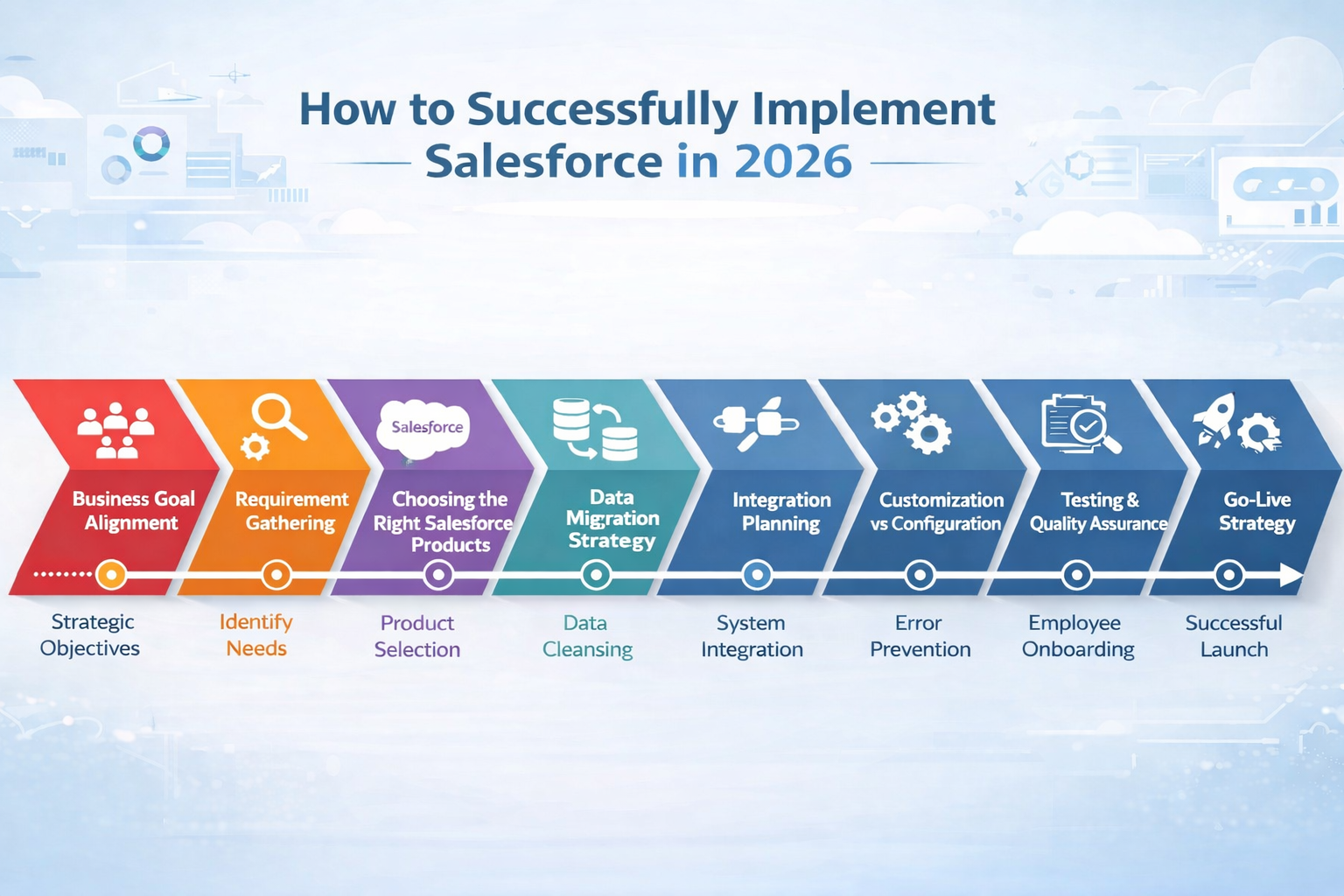
1. Business Goal Alignment
- The first and most critical step is to clearly define what you want to achieve with Salesforce.
- Businesses should identify key pain points such as low sales conversion, poor lead tracking, or inefficient customer service processes.
- Setting clear and measurable KPIs ensures that the implementation is goal-oriented rather than feature-driven.
- This alignment helps in building a system that directly contributes to business outcomes like revenue growth and operational efficiency.
- It is also important to align Salesforce goals with your overall business strategy, ensuring consistency across departments.
- Involving leadership and key stakeholders at this stage helps create a shared vision and clear expectations.
- Defining short-term and long-term objectives ensures that your Salesforce implementation supports both immediate improvements and future scalability.
- A strong goal alignment phase reduces confusion later and ensures that every decision made during implementation has a clear business purpose.
2. Requirement Gathering & Process Mapping
- Understanding your current workflows is essential to designing an effective Salesforce system.
- Organizations should document existing processes, identify inefficiencies, and define the desired future state.
- This step ensures that Salesforce is configured to fit your business processes instead of forcing your team to adapt to generic workflows.
- Proper requirement gathering reduces rework, minimizes costs, and ensures a smoother implementation.
- It is important to involve end-users in this phase to understand real-world challenges and daily workflows.
- Businesses should identify automation opportunities to eliminate repetitive manual tasks.
- Creating detailed process maps helps visualize how data and tasks will flow within Salesforce.
- Clear documentation ensures better communication between business teams and technical teams.
- This phase lays the foundation for a user-friendly and efficient CRM system.
3. Choosing the Right Salesforce Products
- Salesforce offers a wide range of products, and selecting the right ones is crucial for success.
- Businesses should evaluate their needs and choose solutions such as Sales Cloud, Service Cloud, or Data Cloud based on their goals.
- Avoid overcomplicating the system by purchasing unnecessary features or licenses.
- A focused and strategic approach ensures scalability and keeps the system manageable.
- It is important to consider your industry-specific requirements when selecting Salesforce solutions.
- Businesses should also evaluate licensing costs and ensure they align with their budget and expected ROI.
- Choosing the right combination of products ensures better performance, usability, and long-term flexibility.
- A well-thought-out selection helps avoid future reimplementation or costly changes.
4. Data Preparation & Migration Strategy
- Data is the backbone of any CRM system, and its quality directly impacts decision-making.
- Businesses must clean, validate, and standardize their data before migrating it into Salesforce.
- A clear migration plan should define what data will be moved, how it will be mapped, and how accuracy will be maintained.
- Starting with clean data ensures better reporting, improved insights, and higher user trust in the system.
- It is important to remove duplicate and outdated records to maintain data integrity.
- Data governance policies should be established to ensure consistency and accuracy over time.
- Proper field mapping ensures that data is transferred correctly without loss or confusion.
- Testing the migration process before full execution helps avoid critical errors.
- A strong data strategy ensures that Salesforce delivers reliable and actionable insights.
5. Integration Planning
- Most organizations use multiple tools such as ERP systems, marketing platforms, and third-party applications.
- Salesforce should be integrated with these systems to create a seamless flow of information across the organization.
- Proper integration eliminates manual data entry, reduces errors, and provides a unified customer view.
- This connected ecosystem enables better decision-making and enhances overall business efficiency.
- Businesses should clearly define which systems need to be integrated and why.
- Understanding data flow direction (one-way or two-way) is critical for accurate synchronization.
- API-based integrations should be planned carefully to ensure performance and scalability.
- Real-time vs batch data synchronization should be decided based on business needs.
- A well-planned integration strategy ensures a fully connected and intelligent business system.
6. Customization vs Configuration
- Salesforce allows both configuration (using built-in tools) and customization (using code and advanced development).
- Businesses should prioritize configuration to keep the system simple, scalable, and easy to maintain.
- Customization should only be used when specific business requirements cannot be met through standard features.
- Following this approach helps avoid complexity and reduces long-term maintenance costs.
- Over-customization can make the system difficult to upgrade and manage in the future.
- Leveraging standard Salesforce features ensures better compatibility with future updates.
- A balanced approach between configuration and customization leads to a flexible yet stable system.
- Keeping the system simple improves user adoption and overall performance.
7. Testing & Quality Assurance
- Testing ensures that the system functions correctly before it is deployed.
- Organizations should perform functional testing, integration testing, and user acceptance testing to identify issues.
- Early detection of errors helps prevent disruptions after go-live.
- A well-tested system builds confidence among users and ensures a smoother transition.
- Testing should cover all business scenarios to ensure complete system reliability.
- Involving end-users in testing helps identify usability issues early.
- Proper documentation of test cases ensures consistency and repeatability.
- Continuous testing during development improves overall system quality.
- A strong QA process ensures a stable and error-free Salesforce environment.
8. User Training & Adoption
- Even the most advanced CRM system will fail if users do not adopt it effectively.
- Businesses should provide role-based training and hands-on sessions to help employees understand how to use Salesforce.
- Simplifying the interface and demonstrating clear benefits can improve adoption rates.
- High user adoption ensures that the organization fully leverages the capabilities of Salesforce.
- Training should be ongoing, not just limited to the initial implementation phase.
- Providing user guides and support resources helps employees adapt quickly.
- Encouraging feedback from users helps improve system usability.
- Gamification and incentives can boost engagement and adoption.
- A strong focus on adoption ensures that Salesforce delivers real business value.
9. Go-Live Strategy
- The go-live phase is where your Salesforce system becomes operational.
- Businesses can choose between a phased rollout or a full-scale launch depending on complexity.
- Monitoring system performance and collecting user feedback during this phase is essential.
- A well-planned go-live reduces risks and ensures minimal disruption to daily operations.
- Having a dedicated support team during go-live helps resolve issues quickly.
- Clear communication with users ensures a smooth transition.
- Backup and rollback plans should be prepared to handle unexpected issues.
- Tracking initial performance metrics helps evaluate system success.
- A structured go-live strategy ensures a confident and controlled launch.
10. Post-Implementation Optimization
- Salesforce implementation does not end at deployment; continuous improvement is key.
- Organizations should track performance metrics and identify areas for enhancement.
- Adding automation, refining processes, and expanding integrations over time ensures sustained value.
- Continuous optimization transforms Salesforce into a long-term strategic asset.
- Regular system audits help identify inefficiencies and improvement opportunities.
- Updating workflows and automation ensures alignment with evolving business needs.
- Gathering user feedback helps enhance usability and performance.
- Leveraging new Salesforce features and updates keeps your system future-ready.
- Continuous optimization ensures that Salesforce remains a powerful driver of growth and innovation.
Common Salesforce Implementation Mistakes to Avoid
Lack of Proper Planning
Starting without a clear strategy leads to confusion and misaligned outcomes. A structured plan ensures smoother execution and better results.
Poor Data Quality
Unclean or duplicate data affects reporting and decision-making. Accurate and well-managed data is essential for CRM success.
Over-Customization
Excessive customization makes the system complex and hard to maintain. Keeping it simple improves scalability and performance.
Low User Adoption
Without proper training, users may not fully utilize the system. High adoption is critical to achieving real business value.
Weak Integration Strategy
Poor integration leads to disconnected systems and data silos. A connected ecosystem improves efficiency and visibility.
No Clear Goals & KPIs
Without defined objectives, measuring success becomes difficult. Clear KPIs ensure a focused and result-driven implementation.
Benefits of Following a Salesforce Implementation Checklist
1. Strategic Benefits
- A Salesforce implementation checklist establishes a clear and structured roadmap, guiding businesses through every stage from planning to optimization.
- It ensures strong alignment between business goals, processes, and CRM capabilities, helping organizations stay focused on outcomes rather than features.
- By providing clarity and direction, it reduces uncertainty and supports confident, well-informed decision-making.
2. Operational Benefits
- A structured checklist helps streamline workflows by eliminating inefficiencies and reducing manual effort, improving overall productivity.
- It accelerates implementation by minimizing confusion, rework, and last-minute changes, ensuring a smooth and efficient execution.
- It also promotes consistency, ensuring that no critical step is overlooked during the implementation process.
3. Collaboration & Team Alignment Benefits
- It enhances collaboration by clearly defining roles, responsibilities, and timelines, ensuring all stakeholders are aligned.
- Teams can communicate more effectively, reducing misunderstandings and improving coordination between business users, technical teams, and partners.
- This alignment leads to better execution and a more cohesive implementation experience.
4. Data & Performance Benefits
- A checklist strengthens data management practices, resulting in accurate, consistent, and reliable data across the organization.
- It enables better tracking progress by helping teams monitor key milestones, KPIs, and performance metrics.
- Improved data visibility leads to more actionable insights and smarter business decisions.
5. Scalability & Future-Readiness Benefits
- It prepares businesses for future growth by building a scalable and flexible CRM foundation.
- Organizations can easily adapt to new requirements, integrations, and technologies without major disruptions.
- This ensures that Salesforce continues to evolve alongside changing business needs and market trends.
6. Business Confidence & ROI Benefits
- A well-structured checklist increases stakeholder confidence by demonstrating a transparent and well-planned implementation strategy.
- It helps maximize ROI by ensuring efficient resource utilization and minimizing costly errors.
- Ultimately, it supports long-term success by turning Salesforce into a strategic asset rather than just a tool.
Future Trends in Salesforce Implementation

- The growing use of AI and automation is transforming how businesses operate, enabling faster decision-making, smarter workflows, and improved efficiency across departments.
- The rise of autonomous CRM systems allows businesses to automate routine tasks, reduce manual effort, and focus more on strategic activities that drive growth.
- There is an increasing focus on real-time data and predictive analytics, helping organizations anticipate customer needs and make proactive, data-driven decisions.
- Businesses are moving toward unified platforms through system integration, ensuring seamless data flow and a complete 360-degree view of customers.
- The adoption of AI agents likeAgentforce is accelerating, allowing companies to automate repetitive processes and enhance productivity with minimal human intervention.
- The expansion of low-code and no-code development is making Salesforce more flexible, enabling faster customization without heavy reliance on developers.
- A stronger emphasis on data security, privacy, and compliance is ensuring that businesses protect sensitive information while maintaining trust and meeting regulatory standards.
Conclusion
A successful Salesforce implementation is not about how quickly the system is deployed, but how effectively it aligns with business goals and delivers measurable results. Companies that focus on planning, process alignment, and user adoption are more likely to unlock the true potential of Salesforce and achieve long-term success.
By following a structured implementation checklist, businesses can reduce risks, improve efficiency, and build a scalable CRM system that supports growth. With the right strategy and continuous optimization, Salesforce becomes more than just a tool—it becomes a powerful engine for driving performance and staying competitive in 2026 and beyond.