 Neel Thakkar
In today’s fast-moving business environment, revenue operations must function as one connected engine. Yet most organizations still rely on separate systems for lead management, quoting, contracting, billing, renewals, and reporting—creating bottlenecks that slow growth and impact customer experience.
Salesforce Revenue Cloud solves this by bringing the entire Lead-to-Cash lifecycle onto a unified platform, where every step is automated, connected, and fully visible to sales, finance, operations, and partners.
This blog breaks down how the journey flows, what it looks like in practice, and how businesses benefit from automating revenue with Salesforce.
Here’s What Leads Up to This
- If you’re arriving at this point in the series, you’ll gain far more clarity and depth by revisiting the foundational articles that set the stage for Revenue Cloud’s full power.
- These earlier explorations introduce the core concepts, architecture, and capabilities that make this final deep dive into the Lead-to-Cash lifecycle even more meaningful, including What Is Salesforce Revenue Cloud? A Complete Guide for Modern Businesses and Breaking Down Salesforce Revenue Cloud: CPQ, Billing, and Subscription Management
Understanding the Lead-to-Cash Lifecycle
- The Lead-to-Cash lifecycle represents the complete journey of turning a prospect into recognized revenue while ensuring accuracy, efficiency, and customer satisfaction at every step. It covers all stages of the revenue process:
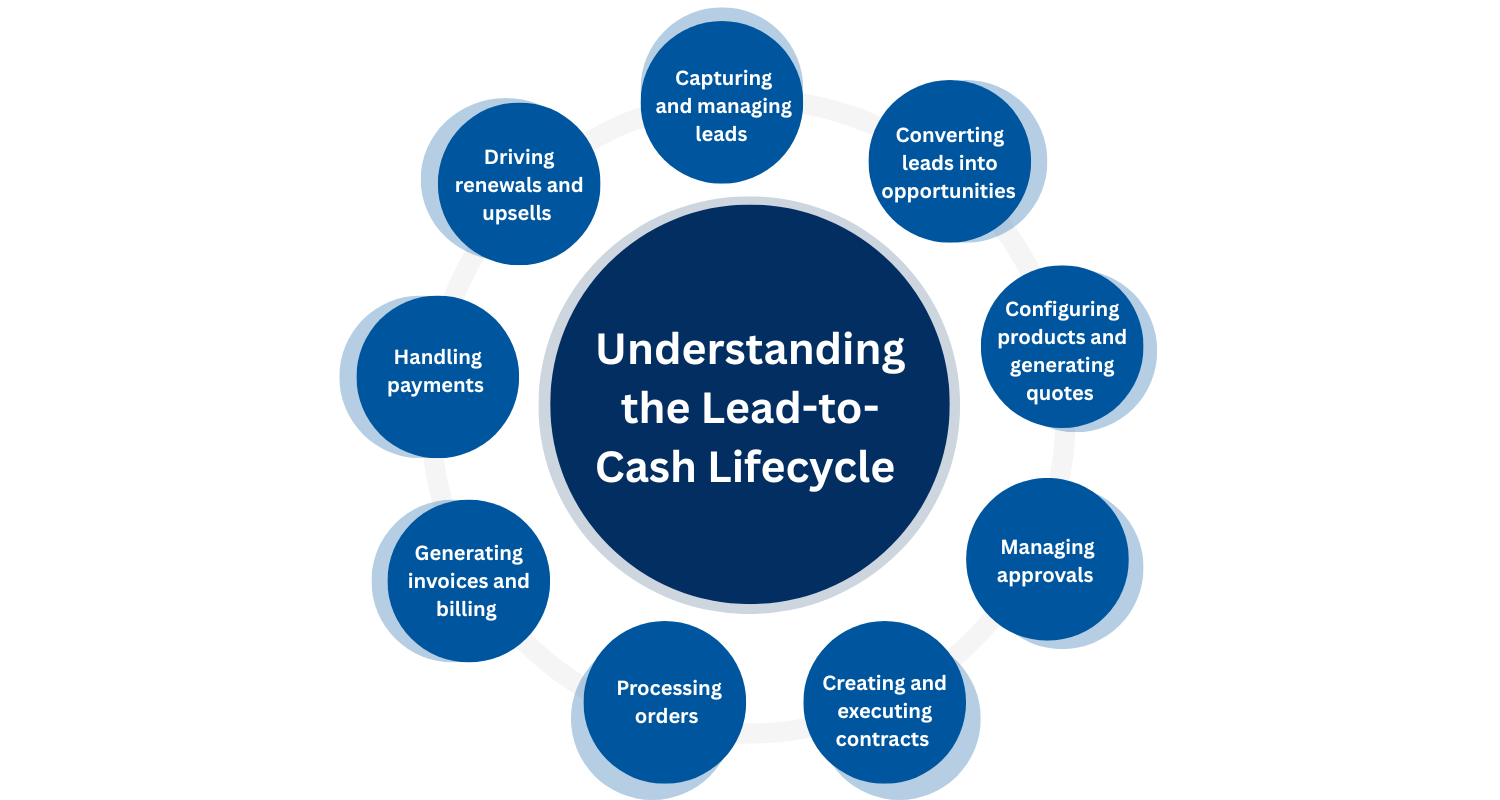
- In many organizations, these steps are managed across separate systems ,CRM platforms, spreadsheets, manual quoting processes, standalone billing tools, and partner portals.
- This fragmented approach often causes delays, errors, and a poor customer experience.
- Salesforce Revenue Cloud solves this by unifying the entire lifecycle on a single platform, enabling seamless workflows, real-time visibility, and accurate reporting from lead capture to revenue recognition and beyond.
How Salesforce Revenue Cloud Automates Every Step?
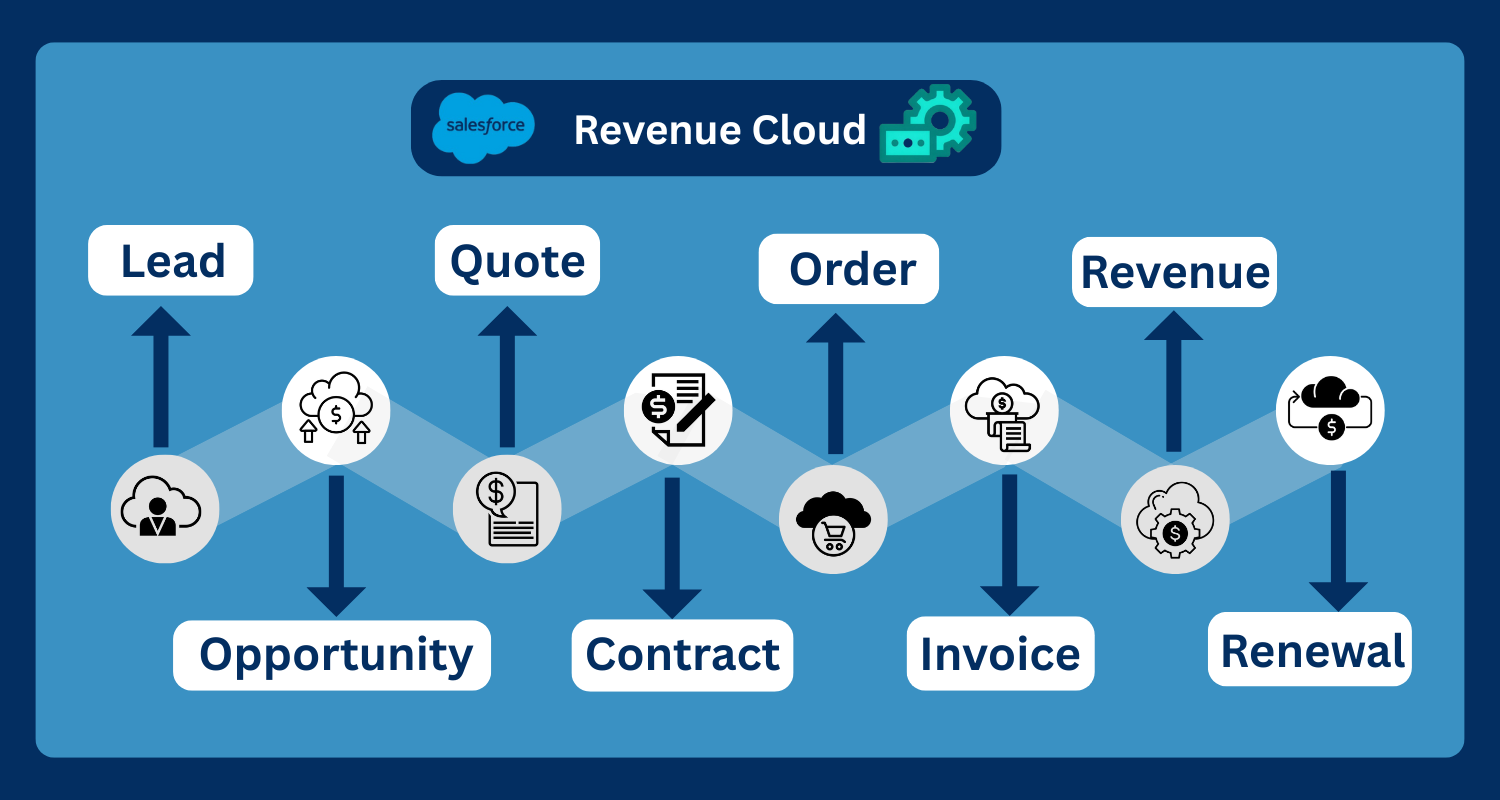
Lead
- The journey starts when a potential customer expresses interest in your product or service.
- Leads can come from marketing campaigns, website forms, referrals, or events.
- Salesforce Revenue Cloud captures these leads, scores them based on engagement and fit, and qualifies the most promising opportunities automatically.
- This ensures your sales team focuses on high-potential prospects while maintaining a clean, organized lead database.
Opportunity
- Once a lead is qualified, it becomes an opportunity a potential deal that can generate revenue.
- Salesforce Revenue Cloud and Sales Cloud provide complete visibility into opportunities, including deal size, probability of closing, and timelines.
- Opportunities are assigned to the right sales representatives, ensuring accountability and faster follow-up.
- Tracking opportunities from the start also improves forecasting and pipeline management.
Quote
- After an opportunity is created, it’s time to generate a quote. Salesforce CPQ (Configure, Price, Quote) automates this process, helping sales teams configure products or services accurately, apply pricing rules, and include discounts if applicable.
- Quotes are generated quickly and consistently, eliminating the errors and delays that occur with manual spreadsheets.
- Customers receive professional, compliant quotes instantly, improving the overall buying experience.
Contract
- Once the customer approves a quote, Salesforce Revenue Cloud helps create contracts automatically.
- This includes capturing terms and conditions, subscription details, and approval workflows for pricing or legal requirements.
- Automated contract generation reduces bottlenecks, ensures accuracy, and provides a clear record of the agreement for both sales and finance teams.
Order
- The approved contract transitions into an order. Salesforce Revenue Cloud ensures all details are transferred accurately products, pricing, quantities, and customer information.
- Orders are processed efficiently, with minimal manual intervention, allowing teams to focus on customer satisfaction rather than administrative tasks.
Invoice
- Once an order is finalized, Salesforce Billing converts it into an invoice.
- This includes managing recurring or usage-based billing, calculating taxes, and sending invoices to customers automatically.
- Automation reduces errors, accelerates cash collection, and provides finance teams with a clear, centralized view of all pending and paid invoices.
Revenue
- Revenue recognition is one of the most critical stages in the Lead-to-Cash process.
- Salesforce Revenue Cloud ensures compliance with accounting standards (GAAP/IFRS), automates deferred and recognized revenue calculations, and provides real-time dashboards.
- Businesses can monitor revenue growth, track performance, and generate accurate reports without manual reconciliation.
Renewal
- The lifecycle doesn’t end after payment. Renewals, upsells, and cross-sells are essential for sustained growth.
- Salesforce Revenue Cloud enables automated renewal reminders, self-service portals for customers, and partner communities for collaboration. CPQ allows customers to generate quotes for upgrades or add-ons, making renewals predictable and scalable.
Real-World Example: Lead-to-Cash in Action
Imagine a SaaS company selling subscription-based software.
Here’s how the fully automated flow looks:
- A marketing campaign brings in a lead
- Sales Cloud qualifies the lead and opens an opportunity
- CPQ guides the rep to choose the right subscription plan
- Approval for discounting happens automatically
- A contract is generated and signed digitally
- Salesforce Billing sends recurring invoices every month
- Payment is collected and recognized
- Renewal reminders are sent automatically
- Customer self-serves upgrades in a community portal
The entire lifecycle runs without manual errors or system switching.
Key Benefits of Automating Lead-to-Cash
- One Connected Revenue Engine: Sales, finance, and operations work on the same data model.
- Faster Sales Cycles: Quotes, approvals, and contracts happen in minutes—not days.
- Zero Billing Mistakes: Automated invoicing reduces disputes and delays.
- Reliable Revenue Forecasting: Real-time visibility from pipeline to recognized revenue.
- Seamless Partner and Customer Experience: Self-service quoting, renewals, and deal collaboration.
- Scalable for Growth: Whether selling subscriptions, hardware, services, or bundles—Revenue Cloud adapts.
How Revenue Cloud Transforms the Revenue Lifecycle
Revenue Cloud goes far beyond automating individual tasks—it re-architects the entire revenue engine. Instead of scattered tools, disconnected data, and manual handoffs, it brings every revenue-driving function onto one intelligent, unified platform.
With Revenue Cloud, businesses can:
Unify the Entire Revenue Journey
Sales, finance, operations, and customer success work from the same data model, eliminating gaps, inconsistencies, and miscommunication.
Automate Every High-Value Step
Complex processes,quoting, discount approvals, contract creation, billing, renewals,run automatically, reducing manual effort and accelerating revenue capture.
Ensure Compliance at Scale
Automated governance, audit-ready processes, and consistent pricing/contracts help teams stay compliant without slowing down sales cycles.
Deliver a Frictionless Customer Experience
Customers get faster quotes, accurate invoices, transparent billing, and seamless renewals—improving retention and lifetime value.
Enable Data-Driven Forecasting
Real-time insights give leaders a clear picture of pipeline health, revenue performance, and renewal readiness—leading to confident, predictable planning.
Support Any Revenue Model
Subscriptions, usage-based billing, services, hardware, bundles, channel sales , Revenue Cloud adapts to all, without redesigning your tech stack.
By integrating every step from lead generation to revenue recognition Revenue Cloud turns the entire lifecycle into a streamlined, intelligent growth engine. Organizations scale faster because every team, every process, and every decision is aligned on the same connected workflow.
Optimizing Your Revenue Lifecycle with Salesforce Revenue Cloud
Revenue Cloud doesn’t just automate individual steps—it optimizes the entire revenue lifecycle. By connecting sales, finance, operations, and customer success teams, it ensures:
- Seamless Workflow: Each step, from lead management to revenue recognition, flows smoothly without delays.
- Data-Driven Decisions: Real-time dashboards and analytics give teams actionable insights to forecast accurately and plan growth.
- Reduced Manual Effort: Automation eliminates repetitive tasks, minimizing errors and freeing teams to focus on strategic initiatives.
- Improved Collaboration: Internal teams, partners, and customers can work together efficiently, reducing bottlenecks and accelerating deal closure.
This holistic approach transforms revenue operations from a series of disconnected tasks into a unified, high-performing engine that drives business growth and enhances customer satisfaction.
Industry-Specific Applications of Revenue Cloud

- Salesforce Revenue Cloud supports a wide range of revenue models, helping businesses automate processes, remove manual bottlenecks, and build predictable, scalable revenue streams. Its flexibility makes it valuable across industries, each benefiting in its own way:
1. SaaS & Technology
For subscription-driven businesses, predictable recurring revenue is critical. Revenue Cloud:
- Automates subscription lifecycle management—from new subscriptions to renewals and upgrades.
- Supports usage-based, tiered, and hybrid pricing models without manual intervention.
- Enables quick generation of accurate quotes for multi-product or multi-year deals.
- Helps reduce churn by offering seamless renewal workflows and proactive upsell opportunities.
The result: faster deal cycles, higher retention, and more reliable ARR forecasting.
2. Manufacturing
Manufacturers often deal with complex product catalogs, configurations, and channel partners. Revenue Cloud simplifies this by:
- Supporting advanced CPQ capabilities such as multi-component configurations and dependency rules.
- Providing partner-friendly quoting and pricing models via PRM and digital portals.
- Ensuring clean handoff from sales to operations through automated order and billing workflows.
- Allowing sales teams to create accurate quotes even for highly customizable products.
Manufacturers gain reduced errors, stronger channel relationships, and a smoother quote-to-delivery pipeline.
3. Healthcare & Life Sciences
Healthcare organizations need accuracy, compliance, and clear visibility in their financial processes. Revenue Cloud provides:
- Automated, compliant billing workflows for various patient services and healthcare plans.
- End-to-end contract and pricing management that meets regulatory requirements.
- Faster approvals for quotes, service packages, or device purchases.
- Streamlined revenue reconciliation for complex billing scenarios.
This helps healthcare providers maintain operational efficiency, transparency, and audit-ready revenue processes.
4. Retail & E-commerce
In fast-moving commerce environments, revenue operations must handle large volumes and dynamic pricing. Revenue Cloud supports retail and D2C brands by:
- Automating promotions, discounts, and bundle pricing at scale.
- Providing a unified system for online, in-store, and marketplace transactions.
- Enabling fast, accurate invoicing and integrated payment workflows.
- Offering cross-channel visibility into customer orders, returns, and renewals.
Retailers can deliver consistent omnichannel experiences and real-time revenue tracking.
Conclusion
A disconnected Lead-to-Cash journey slows sales, introduces billing errors, and creates a poor customer experience. Salesforce Revenue Cloud unifies all touchpoints into one automated, intelligent flow.
From lead qualification to revenue recognition, every step becomes faster, more accurate, and more scalable.
If your business is ready to modernize its revenue engine, Salesforce Revenue Cloud is the solution that brings alignment, automation, and complete visibility.