 Neel Thakkar

AI is transforming how businesses access and interact with enterprise software. Instead of switching between applications, searching through dashboards, and manually navigating CRM screens, users increasingly expect AI to understand their business context and help them complete tasks where they work. Salesforce is responding to this shift with AIforce, an interface layer designed to bring Salesforce data, business logic, workflows, security, and governance to the AI tools and interfaces where people and AI agents work.
With AIforce, Salesforce capabilities can move beyond the traditional CRM interface and become accessible through different AI-powered experiences. This creates a more flexible way to connect Salesforce with the tools and interfaces users already rely on. In this blog, we’ll explore what AIforce is, how it works, the technologies behind it, its benefits, challenges, and its future in AI-powered Salesforce solutions.
What Is AIforce?
- AIforce is Salesforce’s approach to making its platform capabilities available across AI-powered interfaces and experiences. It helps businesses extend Salesforce beyond the traditional CRM screen.
- It allows Salesforce data, business logic, workflows, permissions, security, and governance to be accessed beyond the traditional Salesforce user interface. This helps AI experiences work with relevant business context.
- Instead of requiring users to open Salesforce for every task, AIforce can bring relevant Salesforce capabilities into the AI tools and interfaces they already use. This can help users complete tasks more efficiently within their existing workflows.
- AIforce helps connect AI applications and agents with Salesforce business data and capabilities, enabling more contextual interactions. AI experiences can use Salesforce data and context to support relevant business tasks.
- It supports a more headless approach to Salesforce, where the underlying platform can power different user experiences without being tied to a single interface. This gives developers more flexibility when designing AI-powered applications.
- For example, users could interact with an AI interface to find customer information, summarize an opportunity, or perform supported Salesforce actions without manually navigating multiple CRM screens. This allows users to access Salesforce information through natural-language interactions.
- For Salesforce developers and architects, AIforce creates new opportunities to build AI-powered experiences using APIs, MCP, skills, plug-ins, and other platform capabilities. These technologies can help connect Salesforce with emerging AI applications and interfaces.
- Ultimately, AIforce shifts the focus from “users interacting with Salesforce” toward “Salesforce capabilities being available wherever users and AI agents work.” This reflects the growing role of AI as an interface for enterprise applications.
How Does AIforce Change the Way We Interact with Salesforce?
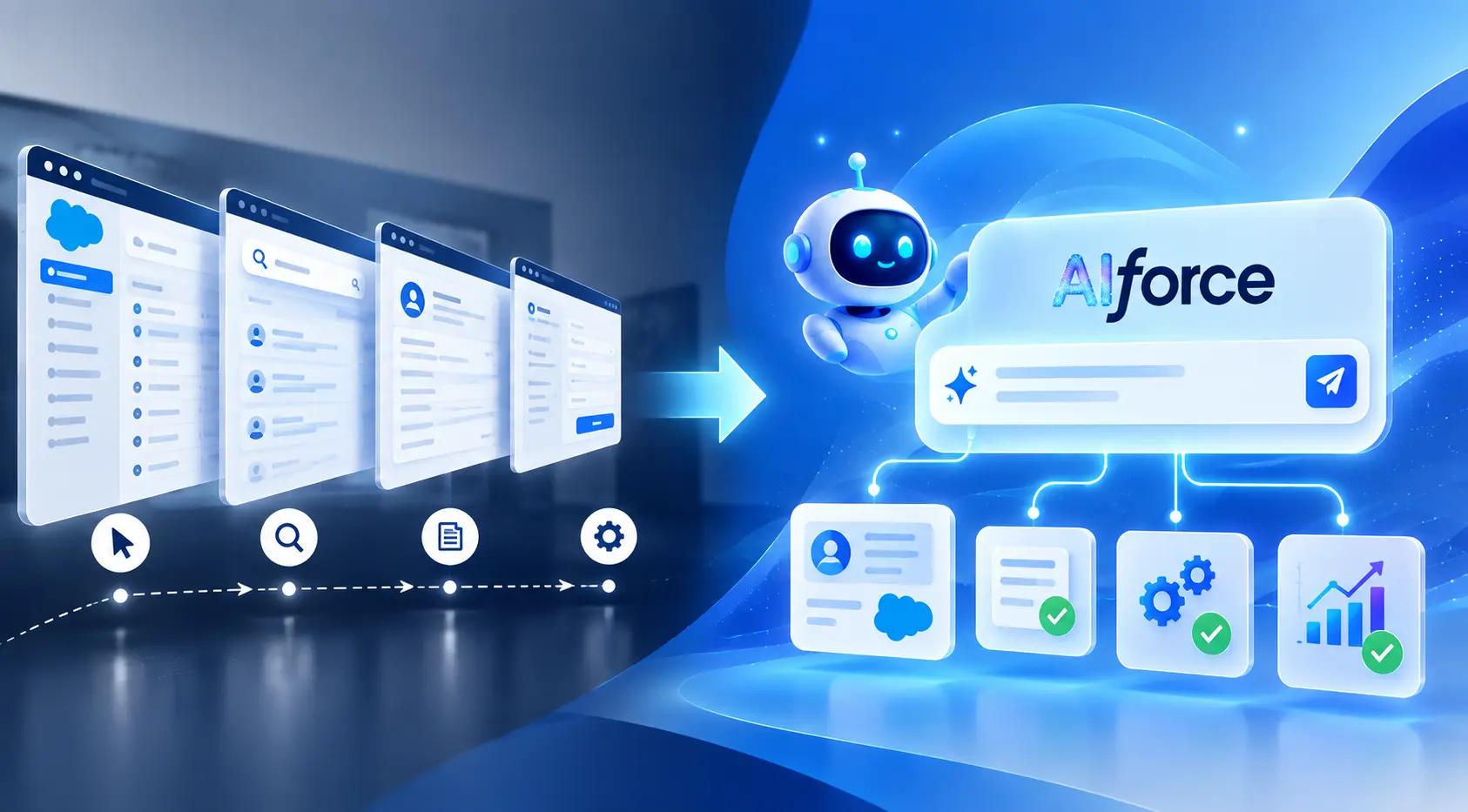
- AIforce moves Salesforce beyond its traditional user interface by making its capabilities accessible through AI-powered experiences. This allows users to interact with business information and processes in more flexible ways.
- Users can communicate with AI interfaces using natural language instead of manually navigating multiple Salesforce screens. This can simplify how users access and complete common CRM tasks.
- AIforce can connect AI experiences with Salesforce data and business processes. This allows AI to work with relevant customer information, workflows, and business logic instead of operating without business context.
- Salesforce capabilities can be exposed through technologies such as APIs, MCP, skills, and plug-ins. These technologies provide different ways for AI applications and agents to interact with Salesforce.
- AIforce can help reduce the gap between AI tools and enterprise CRM systems. Users can potentially access Salesforce capabilities from the environments where they already work.
- The approach also gives developers and architects more flexibility when designing AI-powered solutions. They can focus on making Salesforce capabilities reusable across different interfaces and applications.
- AIforce shifts the focus from building only Salesforce-based experiences to building experiences powered by Salesforce. This creates new possibilities for AI applications, agents, and headless architectures.
How Does AIforce Work?
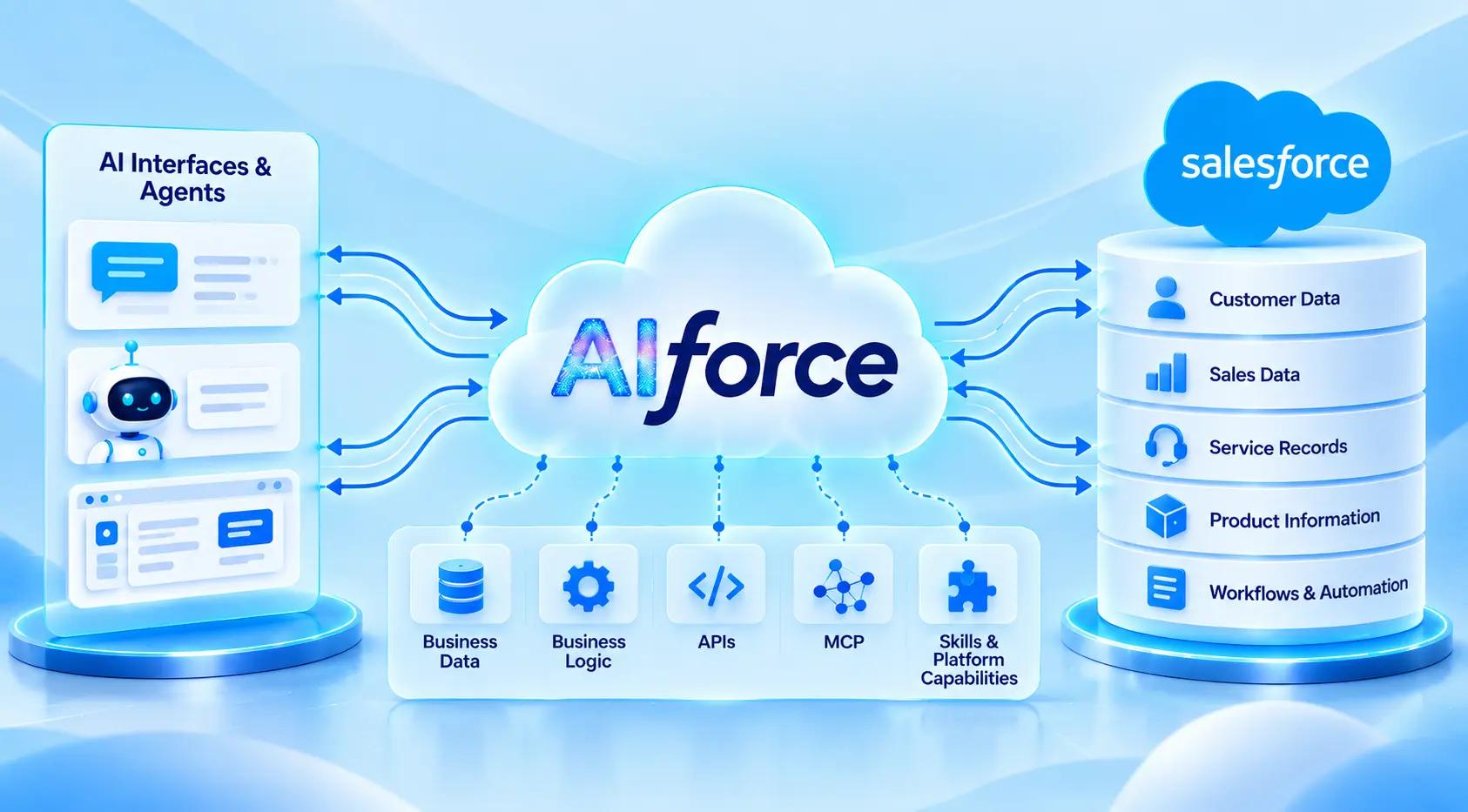
AIforce works by making Salesforce capabilities available to AI interfaces and agents through a combination of business data, business logic, APIs, MCP, skills, and other platform capabilities. These capabilities give AI experiences the context and tools needed to work with Salesforce more effectively.
1. Connect AI With Salesforce Data
- AIforce enables AI experiences to access relevant Salesforce business data and information.
- This can include customer information, sales data, service records, product information, and other business-specific data.
- Providing AI with the right business context helps it generate responses and perform tasks based on actual Salesforce information.
- This creates a connection between AI experiences and the data that businesses already manage within Salesforce.
2. Bring Business Logic Into AI Experiences
- Salesforce contains more than data; it also includes business rules, workflows, processes, permissions, and automation.
- AIforce helps make these capabilities available to AI-powered experiences instead of requiring developers to recreate business logic for every new AI application.
- For example, an AI experience could work with existing processes for updating records, creating tasks, or handling approvals.
- This allows AI interactions to follow the organization's existing Salesforce business processes.
3. Connect Through APIs and MCP
- AIforce uses technologies such as APIs and Model Context Protocol (MCP) to connect AI experiences with Salesforce capabilities.
- APIs provide established ways for applications to retrieve data and perform supported Salesforce operations.
- MCP provides a standard way for AI applications to connect with and use tools and resources.
- Together, these technologies can help developers connect Salesforce capabilities with different AI applications and agents.
4. Make Salesforce Capabilities Available Across Interfaces
- The key idea behind AIforce is that Salesforce capabilities do not have to remain limited to the traditional Salesforce interface.
- AI applications, agents, and other interfaces can interact with Salesforce capabilities through supported technologies.
- This allows developers and architects to design experiences around where users work, rather than requiring users to always work inside Salesforce.
- As a result, Salesforce can act as the underlying business platform while different AI interfaces become the interaction layer.
Why Does AIforce Matter?
- AI is reshaping how users access and work with enterprise software. Instead of navigating menus and screens, users can increasingly describe what they need in natural language and expect AI to help them find information or complete tasks.
- Traditional CRM experiences are built around a predefined interface. Users typically open Salesforce, search for records, review information, and then perform actions through different screens.
- AIforce changes this interaction model by making Salesforce capabilities available beyond the traditional CRM interface. Users and AI agents can potentially interact with Salesforce through the AI tools and interfaces where they already work.
- Salesforce can continue to provide the underlying data, business logic, workflows, permissions, security, and governance. The interaction layer can change without requiring the entire business platform to be replaced.
- This gives businesses more flexibility in how Salesforce capabilities are consumed. Different AI applications, agents, and interfaces can connect with Salesforce capabilities based on specific business requirements.
- AIforce also creates new opportunities for Salesforce developers and architects. They can design reusable business capabilities that can support multiple AI-powered experiences instead of building functionality only for a single Salesforce interface.
- Technologies such as APIs, MCP, skills, plug-ins, and developer tools support this more flexible approach. These technologies provide different ways to connect Salesforce capabilities with AI applications and agents.
- The broader idea is simple: Salesforce does not always have to be the interface where work happens. Instead, Salesforce can provide the business capabilities behind the AI experiences where users and agents work.
How Is AIforce Different From the Traditional Salesforce UI?
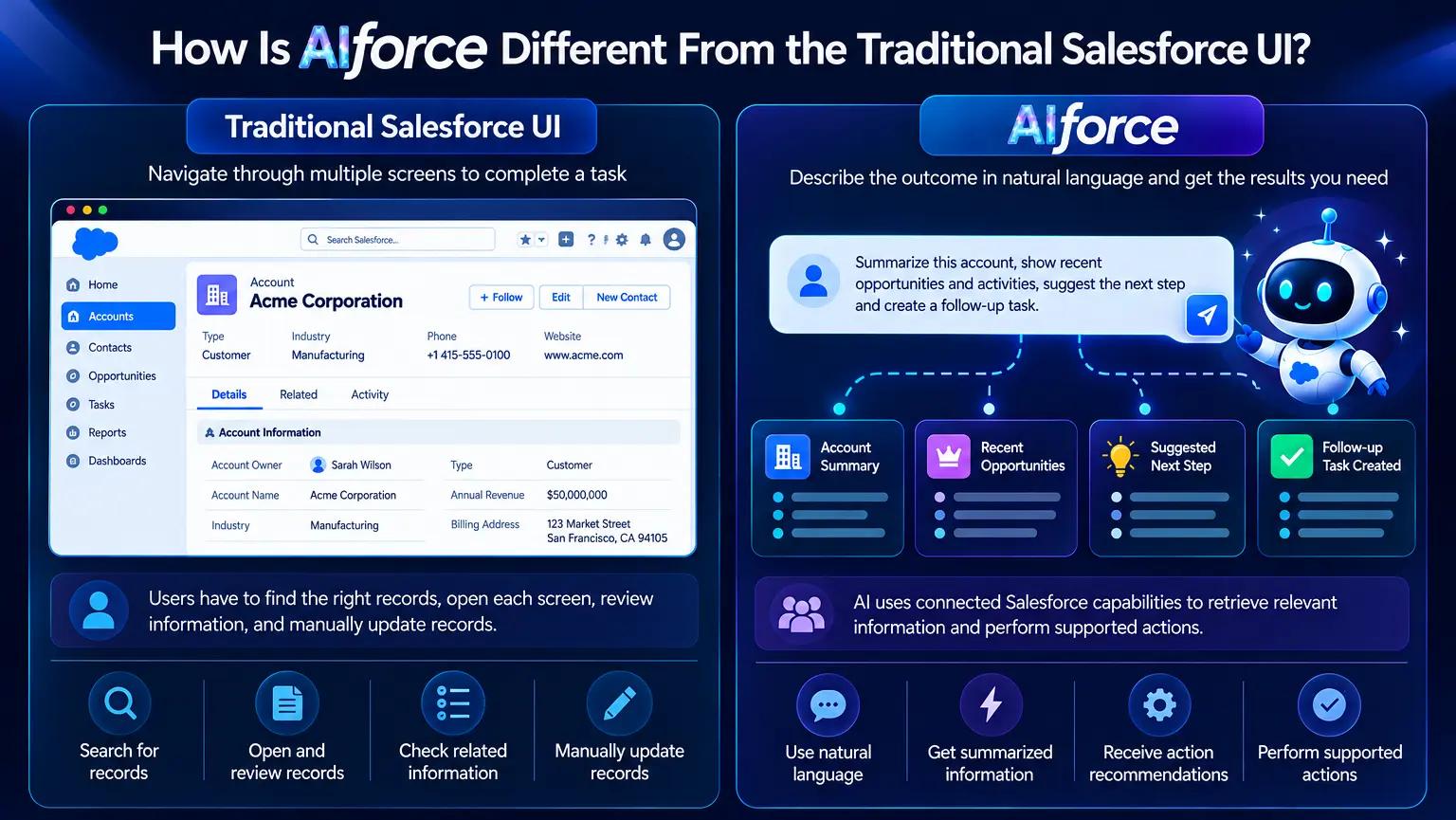
- Traditional Salesforce interaction usually requires users to navigate through multiple screens to complete a task. A sales representative may need to search for an account, open the record, review opportunities and activities, check customer information, and then update the required records.
- This process can involve several steps before the user reaches the desired information or completes an action. The user remains responsible for finding the right records and navigating through the Salesforce interface.
- With an AI-powered interaction, the user can describe the desired outcome in natural language. For example, a user could ask AI to review an account, summarize recent opportunity activity, suggest the next step, and create a follow-up task.
- The AI interface can use connected Salesforce capabilities to retrieve relevant information and perform supported actions. This allows the user to interact with Salesforce capabilities without manually navigating through every screen.
- The main difference is the interaction model, not necessarily the underlying Salesforce platform. Salesforce can continue to provide the data, business logic, workflows, permissions, and security behind the experience.
- AIforce enables Salesforce capabilities to be accessed through different AI-powered interfaces. This gives organizations more flexibility in how users and AI agents interact with their CRM.
- For Salesforce developers and architects, this represents a shift from building only interface-driven experiences to building reusable business capabilities. These capabilities can potentially support multiple interfaces and AI applications.
- In simple terms, the traditional approach brings the user to Salesforce, while the AIforce approach can bring Salesforce capabilities to the interface where the user is already working.
What Technologies Power AIforce?
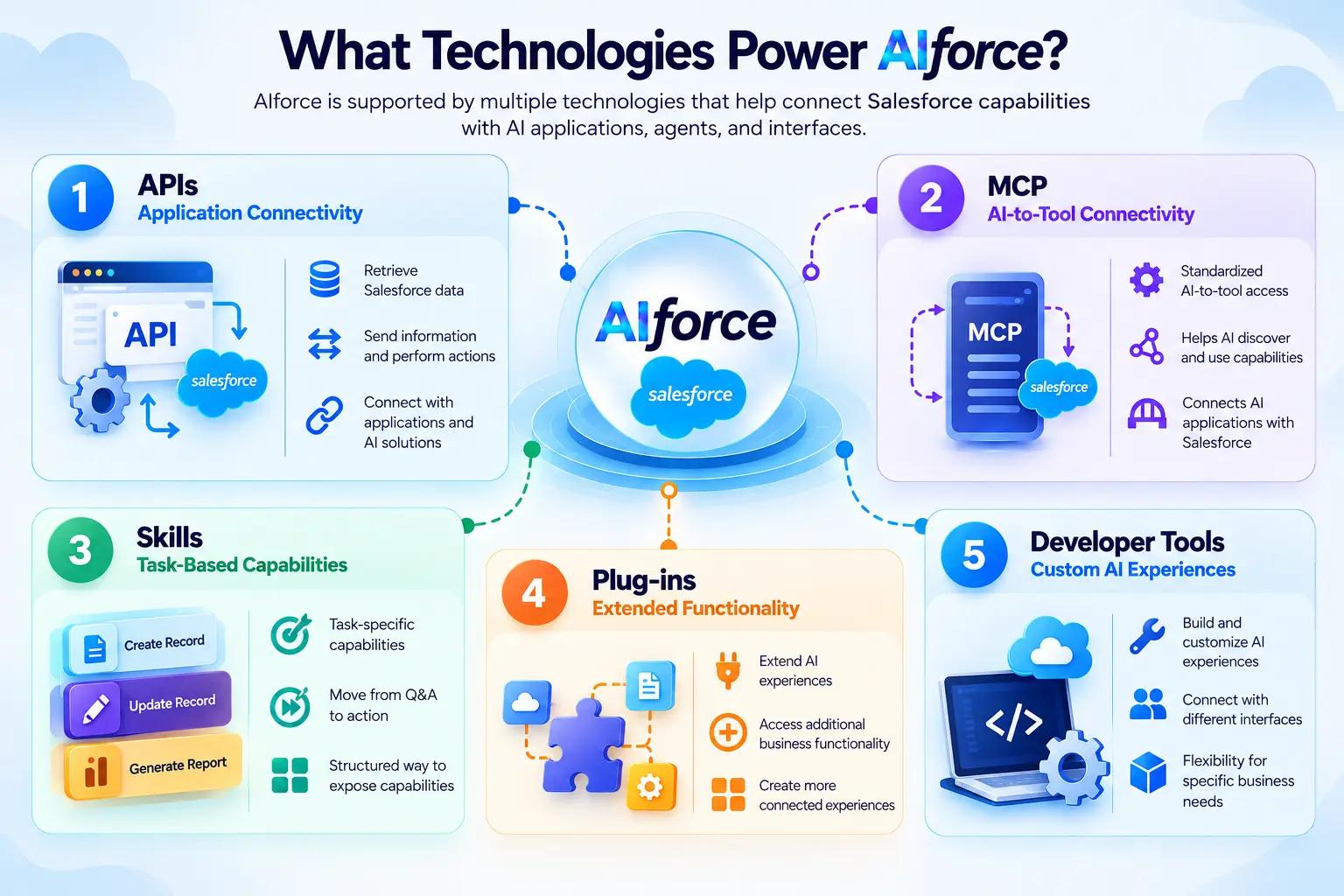
AIforce is supported by multiple technologies that help connect Salesforce capabilities with AI applications, agents, and interfaces.
1. APIs
- APIs provide a programmatic way for external applications to communicate with Salesforce.
- They can be used to retrieve Salesforce data, send information to Salesforce, and perform supported operations.
- APIs remain important for connecting Salesforce with both traditional applications and newer AI-powered solutions.
2. MCP
- Model Context Protocol (MCP) provides a standardized way for AI applications to interact with tools and resources.
- It can help AI systems discover and use Salesforce capabilities through supported MCP connections.
- MCP can therefore act as a bridge between AI applications and enterprise business capabilities.
3. Skills
- Skills package specific capabilities that an AI system can use to accomplish a particular task.
- They can help AI move beyond simply answering questions toward completing business-related tasks.
- Skills can also provide a more structured way to expose specific Salesforce capabilities to AI experiences.
4. Plug-ins
- Plug-ins can extend an AI experience by connecting it with additional business functionality.
- They can allow AI applications to access capabilities that are not available within the AI interface itself.
- This can help create more connected and task-oriented AI experiences.
5. Developer Tools
- Developer tools give Salesforce professionals the resources needed to build and customize AI-powered experiences.
- Developers can use these tools to connect Salesforce capabilities with different applications, interfaces, and AI workflows.
- This provides greater flexibility for building solutions based on specific business and technical requirements.
How Are AIforce and Agentforce Different?
- AIforce and Agentforce are related to Salesforce technologies, but they serve different purposes within the broader AI ecosystem.
- AIforce focuses on making Salesforce capabilities available across AI interfaces and agentic experiences. It helps bring Salesforce data, business logic, workflows, and other capabilities to the interfaces where users and AI agents work.
- Agentforce focuses on building and operating AI agents that can reason, retrieve information, and take actions. These agents can work with Salesforce data and business processes to support specific business use cases.
- AIforce is primarily about the accessibility and delivery of Salesforce capabilities. It allows those capabilities to be used through different AI-powered interfaces.
- Agentforce is primarily about the AI agent itself. It provides the capabilities needed to create agents that can understand requests, make decisions, and perform supported actions.
- Data 360 provides the data and business context that AI experiences and agents can use. It helps bring relevant information together to support more contextual AI interactions.
- The Salesforce Platform provides the underlying foundation for applications, data, automation, security, and development. These capabilities can support both AIforce and Agentforce solutions.
- MCP and APIs provide ways for AI applications and agents to connect with Salesforce capabilities. They can help AI experiences access data, tools, and supported business operations.
- These technologies are not necessarily alternatives to one another. They can work together to create AI-powered experiences that combine Salesforce data, business logic, AI agents, and different interfaces.
- In simple terms, Agentforce helps build the agent, while AIforce helps make Salesforce capabilities available to the interfaces and experiences where that agent or user works.
How Does AIforce Connect Salesforce With AI Experiences?
AIforce can be understood through different connection and interaction layers that allow Salesforce capabilities to work with AI applications and agents.
1. Data Access
- AIforce can make relevant Salesforce data available to AI-powered experiences through supported connection methods.
- This allows AI applications to work with business information such as customer, sales, service, and operational data.
- Access to relevant Salesforce data gives AI experiences the business context needed for specific tasks.
2. Business Logic
- AIforce can connect AI experiences with Salesforce business logic, workflows, and automation.
- This allows AI-powered experiences to work with existing business processes instead of treating Salesforce as a simple data source.
- Reusing existing business logic can help organizations maintain consistency across different AI-powered experiences.
3. Tool Connectivity
- AI applications need access to tools and capabilities when they are expected to perform tasks rather than only provide responses.
- Technologies such as APIs and MCP can provide ways for AI applications and agents to interact with supported Salesforce capabilities.
- This creates a connection between AI interfaces and the tools required to complete specific business tasks.
4. AI Agents
- AI agents can use connected Salesforce capabilities to perform supported tasks based on user requests and business requirements.
- Agents can potentially retrieve information, work with business processes, and initiate approved actions.
- This allows Salesforce to become part of more autonomous and task-oriented AI workflows.
5. Security and Permissions
- AIforce implementations need to ensure that AI applications and agents operate within appropriate Salesforce security and permission boundaries.
- Access controls can determine what data and capabilities a particular user or AI agent can use.
- This helps organizations maintain security and governance as Salesforce becomes more connected to AI experiences.
6. Multiple Interfaces
- AIforce enables Salesforce capabilities to support different AI-powered interfaces rather than relying only on the traditional Salesforce UI.
- Users can potentially interact with Salesforce through AI applications, agents, and other connected experiences.
- This creates a more flexible architecture where Salesforce provides the business capabilities while different interfaces provide the interaction layer.
How Does AIforce Improve Salesforce Security?
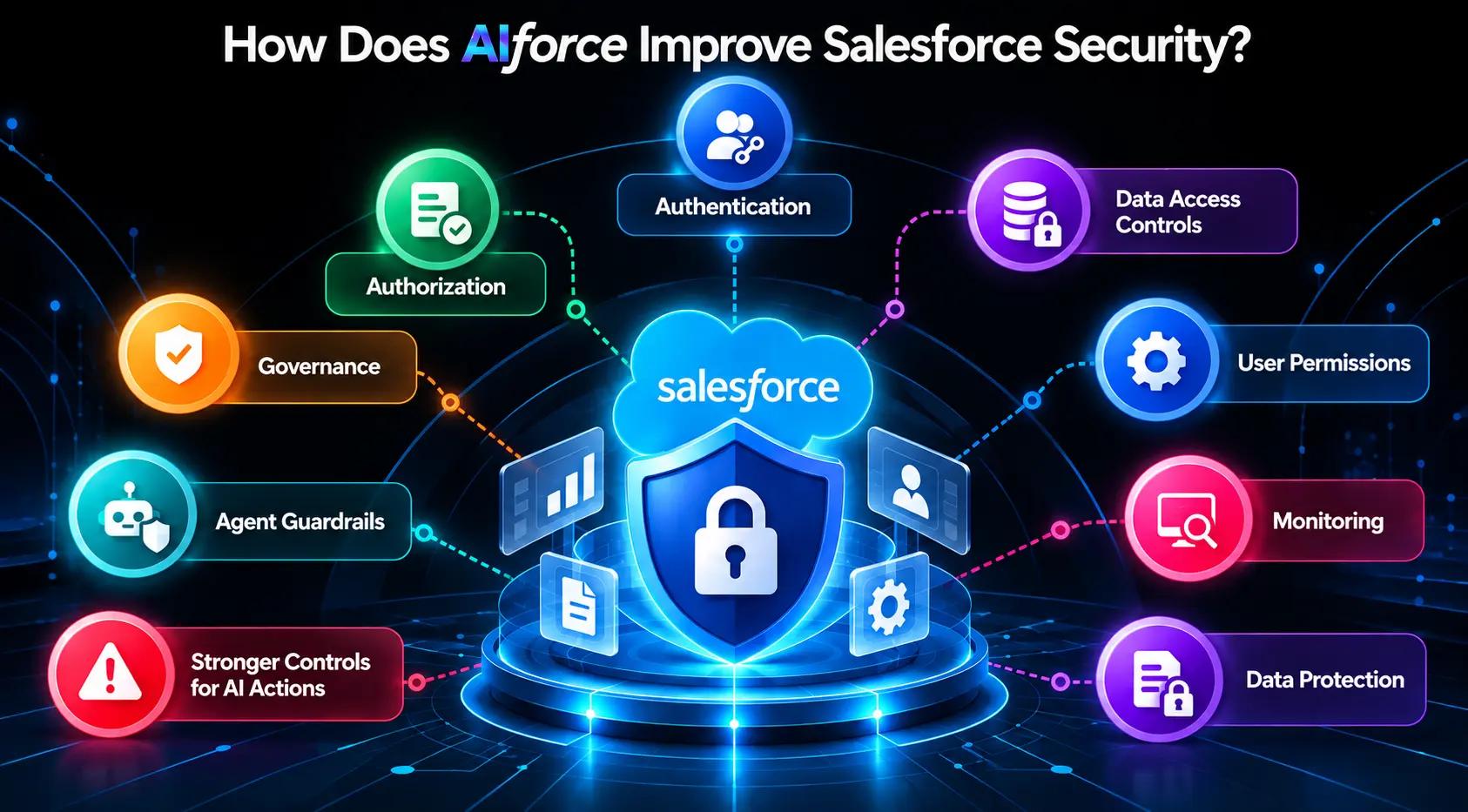
- Security remains an important consideration when Salesforce capabilities are made available through AI-powered interfaces. Extending Salesforce beyond its traditional UI does not mean that existing security and governance controls should be overlooked.
- AIforce is designed to bring Salesforce security and governance into headless and AI-powered experiences. This helps organizations maintain appropriate controls while connecting Salesforce capabilities with different AI interfaces and agents.
- Authentication ensures that users and connected systems are properly identified before accessing Salesforce capabilities. This helps prevent unauthorized access to business information.
- Authorization determines what a particular user, application, or AI agent is allowed to access or perform. Different users and agents may require different levels of access based on their roles and responsibilities.
- Data access controls help determine which Salesforce information can be made available to an AI experience. This is particularly important when AI applications work with sensitive customer or business data.
- User permissions help ensure that AI-powered actions follow the access rights associated with the relevant user or context. AI should not automatically receive broader access simply because it is connected to Salesforce.
- Governance provides policies and controls for managing how AI interacts with Salesforce capabilities. Organizations can use governance practices to define acceptable AI usage and business processes.
- Agent guardrails can help control what AI agents are allowed to do. These controls become especially important when agents can take actions rather than simply provide information.
- Monitoring helps organizations track AI interactions, activities, and actions involving Salesforce capabilities. This can support visibility, troubleshooting, auditing, and ongoing governance.
- Data protection helps safeguard Salesforce information as it moves between users, AI applications, agents, and connected systems. Organizations need to consider how business data is handled throughout the entire AI workflow.
- The security requirements become more important when AI agents can perform business actions. An AI agent that only retrieves information presents a different risk profile from one that can update records or initiate processes.
- For example, an AI agent that can read an opportunity record may have limited impact, while an agent that can update the opportunity, trigger a workflow, or modify customer information requires stronger controls. This makes permissions, guardrails, monitoring, and governance essential parts of an AIforce implementation.
What Are the Benefits of AIforce?
1. More Flexible User Experiences
- AIforce allows Salesforce capabilities to be accessed through different AI-powered interfaces instead of being limited to the traditional Salesforce UI.
- Businesses can create experiences that fit different user workflows and business requirements.
- This gives organizations more flexibility in how employees and AI agents interact with Salesforce.
2. Reduced Context Switching
- AIforce can help users access relevant Salesforce information and capabilities directly through the AI tools they use.
- Users may spend less time switching between CRM screens and separate AI applications.
- This can create a more connected workflow for everyday business tasks.
3. Reuse of Existing Business Logic
- AIforce can help businesses extend existing Salesforce data, automation, workflows, and business processes into new AI experiences.
- Organizations do not necessarily need to recreate their existing business logic for every new AI application.
- This can help businesses build on their existing Salesforce investment while adopting new AI technologies.
4. Better Business Context for AI
- AI experiences can become more useful when they have access to relevant Salesforce business data and processes.
- AIforce can bring Salesforce context such as data, business logic, workflows, permissions, security, and governance into AI-powered experiences.
- This can help AI interactions become more relevant to the organization's actual business environment.
5. New Opportunities for Developers and Architects
- AIforce gives Salesforce developers and architects new opportunities to build experiences beyond traditional Salesforce pages.
- Developers can work with technologies such as APIs, MCP, Agentforce, Salesforce data, automation, and external AI interfaces.
- This expands the scope of Salesforce development toward AI-powered, headless, and connected applications.
6. Greater Potential for AI-Powered Automation
- AIforce can help connect AI experiences with Salesforce capabilities that support business processes and actions.
- AI agents can potentially move beyond answering questions and interact with supported Salesforce capabilities to complete tasks.
- This creates opportunities to build workflows where AI can help users move from finding information to taking action.
How Does AIforce Impact Salesforce Developers and Architects?
- AIforce does not eliminate the need for Salesforce developers and architects; instead, it expands the skills required for AI-powered Salesforce solutions.
- Salesforce developers may increasingly work across Salesforce development, AI, integration, and governance. This can include Apex, LWC, Flows, APIs, AI agents, MCP, and external AI applications.
- Developers may need to understand how AI agents interact with Salesforce capabilities. Knowledge of Agentforce APIs, SDKs, Agentforce DX, Agent Script, and AI development tools can become increasingly valuable.
- Integration becomes an important part of AI-powered Salesforce development. Developers may work with REST APIs, MCP, middleware, external systems, and event-driven architectures.
- Salesforce architects need to make decisions about data, business logic, integrations, and AI agents. They must determine which Salesforce capabilities should be exposed to AI and how those capabilities fit into the overall architecture.
- Security and governance become critical when AI systems can access Salesforce data or perform business actions. Architects and developers need to consider permissions, authentication, authorization, guardrails, monitoring, and human approval.
- AIforce expands the role of Salesforce professionals from building CRM functionality to designing AI-ready business capabilities. Developers focus on implementation while architects ensure these capabilities are secure, scalable, connected, and aligned with business requirements.
What Challenges Should Businesses Consider Before Adopting AIforce?
AIforce creates new opportunities for AI-powered Salesforce experiences, but organizations should evaluate several factors before implementing it.
1. Data Quality
- AI experiences depend on accurate, complete, and well-structured Salesforce data.
- Poor-quality, outdated, or inconsistent CRM data can affect the relevance and reliability of AI-generated responses.
- Organizations should review and improve their data quality before using Salesforce data in AI-powered workflows.
2. Security and Access Control
- Organizations need to control which users, applications, and AI agents can access Salesforce data and capabilities.
- Permissions should be carefully designed to prevent AI systems from accessing information beyond their intended scope.
- Additional controls may be required when AI agents can modify records or perform business actions.
3. AI Governance
- Organizations need clear policies for how AI systems and agents can use Salesforce capabilities.
- Businesses should define which actions AI can perform independently and which actions require human approval.
- Governance should also cover monitoring, accountability, and responsible use of AI.
4. Integration Complexity
- Connecting Salesforce with external AI applications and interfaces can require careful technical planning.
- Developers and architects may need to evaluate APIs, MCP, middleware, authentication, and existing integration architecture.
- Poorly planned integrations can create unnecessary complexity and maintenance requirements.
5. AI Reliability
- AI responses and actions should be tested before they are used in important business processes.
- Organizations need to evaluate whether AI provides accurate information and follows the expected business logic.
- Human oversight can remain important for sensitive or high-impact decisions.
6. Architecture and Scalability
- AIforce implementations should be designed to support the organization's current and future AI requirements.
- Architects need to consider data access, system performance, integrations, security, and the number of AI experiences being supported.
- A scalable architecture can help organizations expand AI use cases without creating disconnected solutions.
7. Change Management and User Adoption
- Introducing AI-powered Salesforce experiences can change how employees perform their daily tasks.
- Users may need training to understand how to interact with AI systems and when to verify AI-generated information.
- Organizations should combine technology adoption with clear processes, user education, and ongoing feedback.
Why AIforce Is Important for the Agentic Enterprise
- The agentic enterprise goes beyond using AI to generate text or answer questions. It focuses on AI agents that can understand business context, make decisions, and perform meaningful tasks.
- AI agents need more than an AI model to perform business tasks effectively. They need access to reliable data, context, business logic, tools, permissions, actions, and governance.
- Salesforce already provides many of these capabilities through its platform. This includes business data, workflows, automation, security, permissions, and tools that support business processes.
- AIforce helps make Salesforce capabilities available across different AI interfaces and experiences. This allows AI applications and agents to work with Salesforce capabilities without being limited to the traditional CRM interface.
- This creates a shift from simply using AI alongside CRM to making CRM capabilities part of AI-powered workflows. AI can potentially move from providing information to helping users complete supported business tasks.
- AIforce can therefore support the evolution from traditional CRM to AI-enabled and agentic CRM experiences. This progression moves from traditional CRM and AI-enabled CRM to agentic CRM and, ultimately, Salesforce capabilities becoming available across AI interfaces.
- The broader opportunity is to connect AI with the systems that already contain an organization's business data and processes. This can help create AI experiences that are more connected to real business operations rather than operating separately from enterprise systems.
What Is the Future of Salesforce with AIforce?
- AIforce points toward a more flexible Salesforce ecosystem where Salesforce capabilities can extend beyond the traditional CRM interface.
- Salesforce can increasingly function as a business platform whose data, business logic, workflows, and capabilities support different AI-powered experiences.
- AI agents can interact with Salesforce data and business capabilities to support users with information and approved business tasks.
- Employees can interact with Salesforce-powered capabilities through AI interfaces instead of always navigating through traditional CRM screens.
- Developers can build more headless Salesforce experiences that make business capabilities available across different applications and interfaces.
- Business processes can be exposed as reusable capabilities that different AI applications and agents can access when appropriate.
- Users can increasingly interact with business systems through natural-language requests, while Salesforce continues to provide the underlying data, logic, security, and governance.
- AIforce therefore supports Salesforce's broader movement toward an agentic enterprise where AI becomes more closely connected to the systems and processes that run the business.
Conclusion
AIforce represents a shift in how Salesforce capabilities can be accessed and used. By bringing Salesforce data, business logic, workflows, security, and governance to AI-powered interfaces, it creates new possibilities for connected enterprise experiences. Technologies such as MCP, APIs, skills, plug-ins, and Agentforce can further support this approach.
For businesses, developers, and architects, AIforce opens new opportunities to build flexible, AI-powered Salesforce solutions. As organizations move toward an agentic enterprise, the future may be less about bringing users to Salesforce and more about bringing Salesforce capabilities to wherever the work happens.